Just how reliable is eyewitness testimony - some essaysEssay 1 Essay 2 Essay 3 Essay 4 Essay 5 Essay 6 |
Persistent claims are made that eyewitnesses "saw" a missile shoot down TWA Flight 800 off East Moriches, Long Island on July 17, 1996.
What credence must be given to such claims? I have attempted to show, in some way, what is or is not visible.
Firstly I calculate the distance of the nearest eyewitness at a nice round 54500 feet. I will be working in feet as that is still the standard American unit of linear measurement.
How do I arrive at this? Simple pythagorean algebra. Witnesses were 52800 feet away and 13700 feet down from TWA800. That give me 54548 feet directly to the aircraft. To make calculations simple I have chosen to use 54500 feet as a "rounded" sum.
By trigonometry I arrive at the fact that the angle of sky covered by TWA800 was 0.24 degrees or 14.45 minutes of angle.
I have used the length 231 foot as the length of the airliner fuselage.
For the graphic representations one needs a 14 inch monitor set at 800 pixels by 600 pixels.
This is a complex subject where many factors need to be taken into consideration. The average human with 20/20 vision can distinguish articles subtending an arc of 1.4 minutes while the best ever recorded could distinguish 28 seconds of arc.
How does this translate to 10 miles?
It means that the average human eye could, under the most ideal of circumstances related to light and contrast, distinguish an item of 22.2 feet by 22.2 or over as an "object". The super-vision gifted person who measured in at 28 seconds of arc would be able to distinguish an object of 7.4 by 7.4 foot.
It must be emphasised that the object would have to be in maximum contrast - black on white or white on black - under conditions of ideal luminesence and with a perfectly clear medium to view it through.
In fact outside of laboratory conditions these numbers would rapidly fall off.
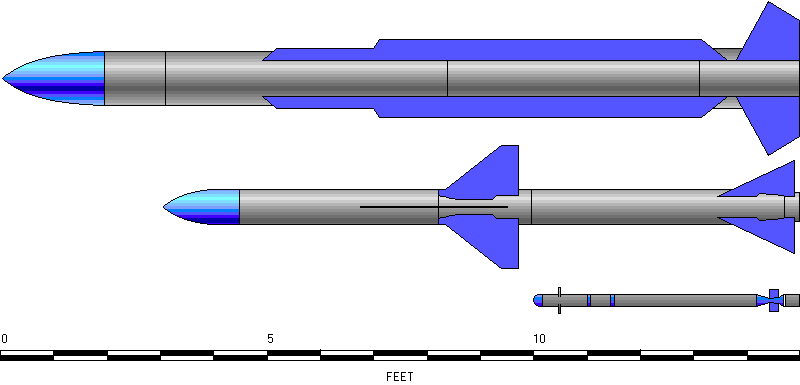
The second missile, though not much mooted by missile proponents, is the Sparrow. It is 12 foot long with a body diameter of 8 inches.
And lastly we have the Stinger. This is much favoured by a certain sector of the missile proponents. It is 5 foot long with a diameter of 2.75 inches.
A depiction of the relative sizes is shown below.
| Designation | Length (feet) | Span (inches) | Diameter (inches) | Weight (pounds) | Min/Max range (miles) | Altitude limits (feet) | Speed | Control | Propulsion | Guidance | Warhead |
|---|---|---|---|---|---|---|---|---|---|---|---|
| Stinger FIM-92 | 5 | 3.5 | 2.75 | 22 | -/3.2 | -/9840 | 2300 fps | Atlantic Research Mk 27 dual-thrust | IR Homing | 2.2 pound fragmentation | |
| Sea Sparrow RIM-7R | 12 | 40 | 8 | 510 | 1/11 | 50/16400 | M3.5+ | Centrebody wings | Hercules Mk 58 boost-sustained. 2.9sec burn | CW SAR | Mk 71 controlled fragmentation high-explosive. 86 lbs. Impact + Prox fuzes |
| Standard SM-2 | 15 | 43 | 14 | 3200/1346 | -/104 | -/656000+ | M2+ | Cruciform Rear Fins | EX-72 booster with Mk 104 dual-thrust | SAR | 25lb. High-explosive controlled fragmentation. Impact + Prox fuses |
Flight TWA 800 was a Boeing 747B. It was 231 foot long with a wingspan of 196 feet.
In the graphic depiction of the airliner below the missiles have been included near the nose, suitably scaled to the size of the airliner. To view this particular graphic as the eyewitnesses on Long Island might have seen it it is necessary to stand 198 feet away from the monitor.
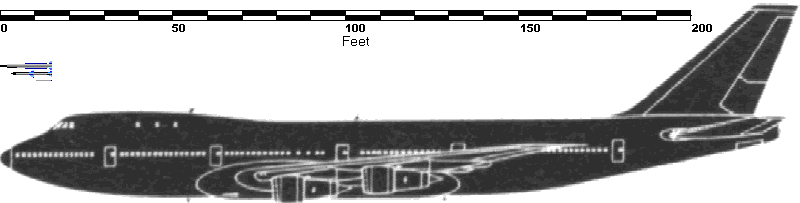
Since this distance is too great for the average computer user I include this graphic - note how details begin to disappear - which can be viewed at 46 feet.

And finally for the chairbound, this one that depicts the view from 6 feet from the monitor. To view it with some relevance to an horizon you can move it to the top of the screen and, if you have a normal monitor, the surface on which it stands will be, roughly, where the horizon was. For the technically minded it was approximately 14.6 degrees above the horizon ignoring the curvature of the earth. At the distances involved anything above 25ft would have been visible to an observer at 10 miles.

It thus becomes rather obvious that whatever was seen by the eyewitnesses was not a guided missile in the inventory of the USN.
A major suspect as a launch platform is a Ticonderoga class missile cruiser.
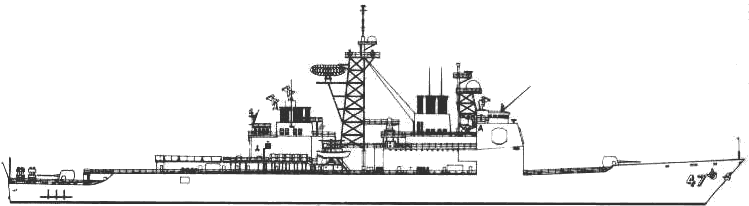
So lets look at what would have been visible at 3 miles, a commonly mooted distance, to an observer with his/her eyes about 10 feet above sea level. Remember this is as seen from 6 feet away from a 14 inch screen displaying at 800 X 600 pixels.

And finally what would have been visible to the same observer at 10 miles distance.

And just compare the two - here's the plane and the ship.
The only other ships of the USN that could have launched a missile are the Spruance/Kidd class destroyers (Sparrow/Standard) or the O.H.Perry class frigates. They are depicted below as they would have appeared from 3 miles offshore.
 |  |
|
| Spruance/Kidd | O.H.Perry |
Of what use was the eyewitness testimony? Very little. Given what was visible, as demonstrated by the graphic above, most would have been pressed to identify the aircraft as a Boeing 747. The more compelling argument is why so many persons were looking at such a tiny object so far away. None of them report having seen equally large aircraft nearer by. The obvious conclusion is that the large majority of eyewitnesses looked only after the destructive event had commenced, their eyes being attracted to the area of sky by the explosions in it. None reported seeing a naval vessel.
Below are some depictions of missiles in flight and being launched. Decide for yourself if any would be identifiable at 10 miles distance.
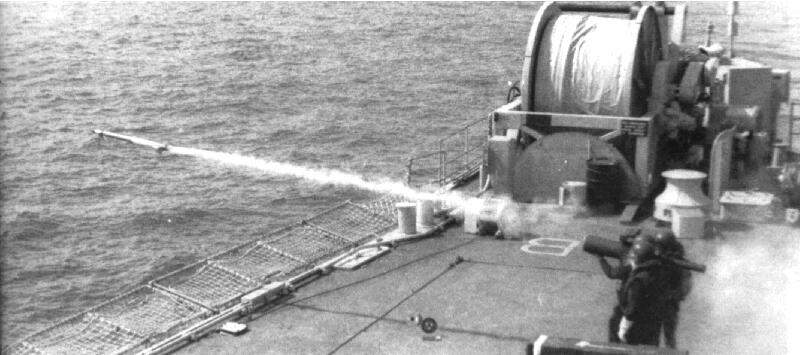
This is the launch of a typical MANPADS missile, the JAVELIN. Notice that its signature is minimal and will decrease to nothing within a few hundred yards of the launch point.
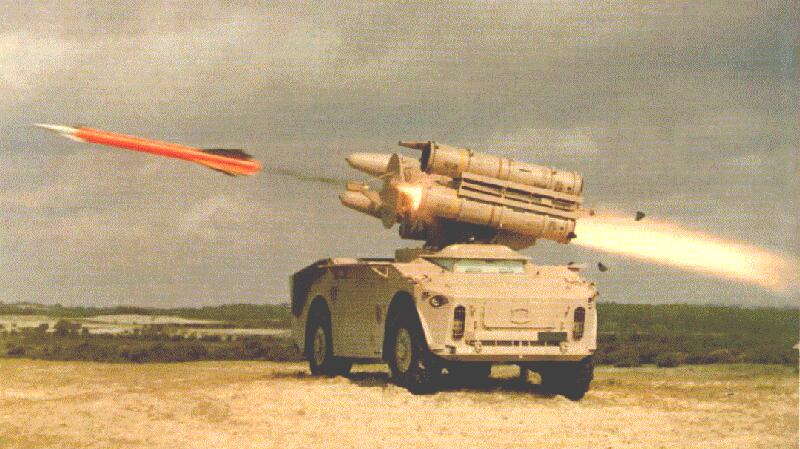
This image shows the launch of a Matra R440 missile from a Crotale launcher. Notice that the boost phase has largely expended itself within the launch container and that the missile itself is showing very little "plume". This missile is smaller than the Sparrow depicted above.
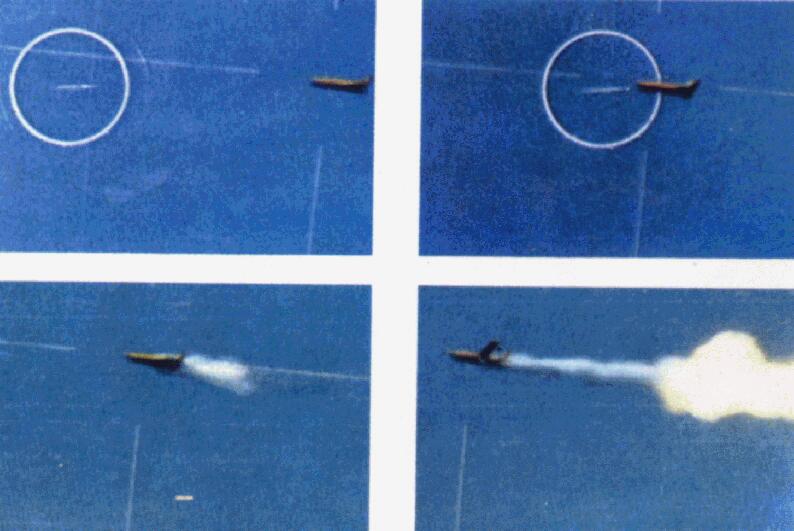
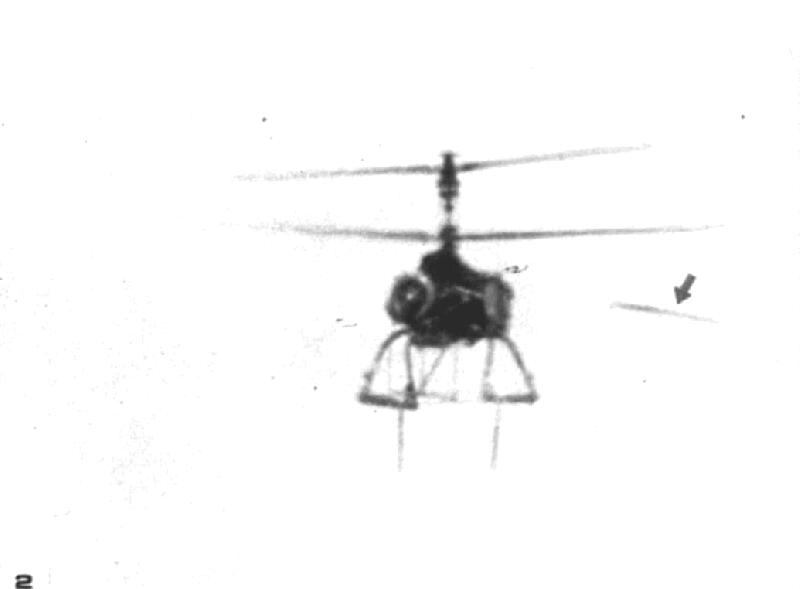
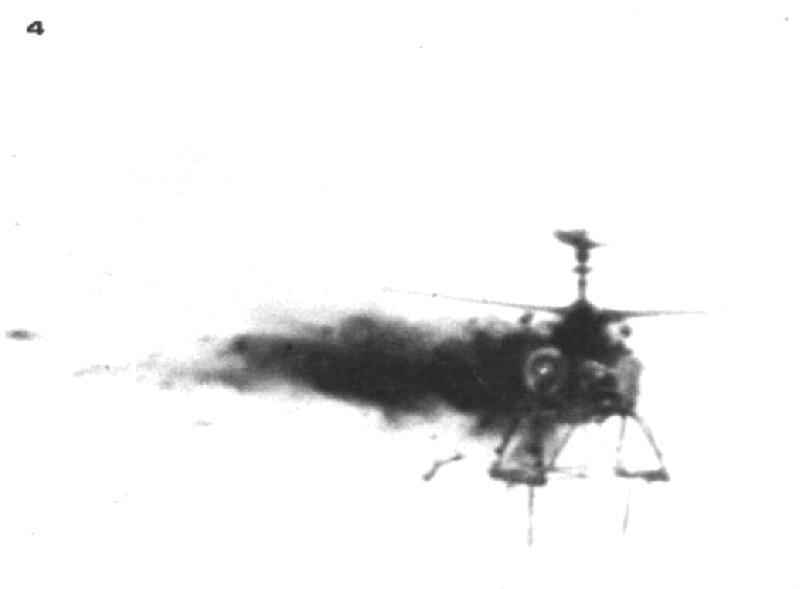
The following pair of photographs show a converted DASH drone helicopter suffering a direct hit from a Stinger missile - the missile is arrowed in the photograph. The quality of these two photos is poor - but they give some indication of the size of a Stinger in flight. The DASH drone itself is very small, as any USN sailor who suffered with their vagaries will attest.
This last graphic is that of a Selenia Aspide missile, the Italian version of the Sparrow to all intents and purposes. The Aspide is ringed in the photographs in which it appears. It is shooting down an Aerospatiale CT20 target drone off Sardinia. The engagement is taking place at between 4 and 5 miles from the radar guided Officine Galileo optical tracker which filmed the engagement through a 8X - 12X zoomable lens.